Technical Description
CELL-INTEGRITY MAGNETIC FREEZING SYSTEM
Cell-Integrity Magnetic Freezing System (CMF)
Impact on Food Quality
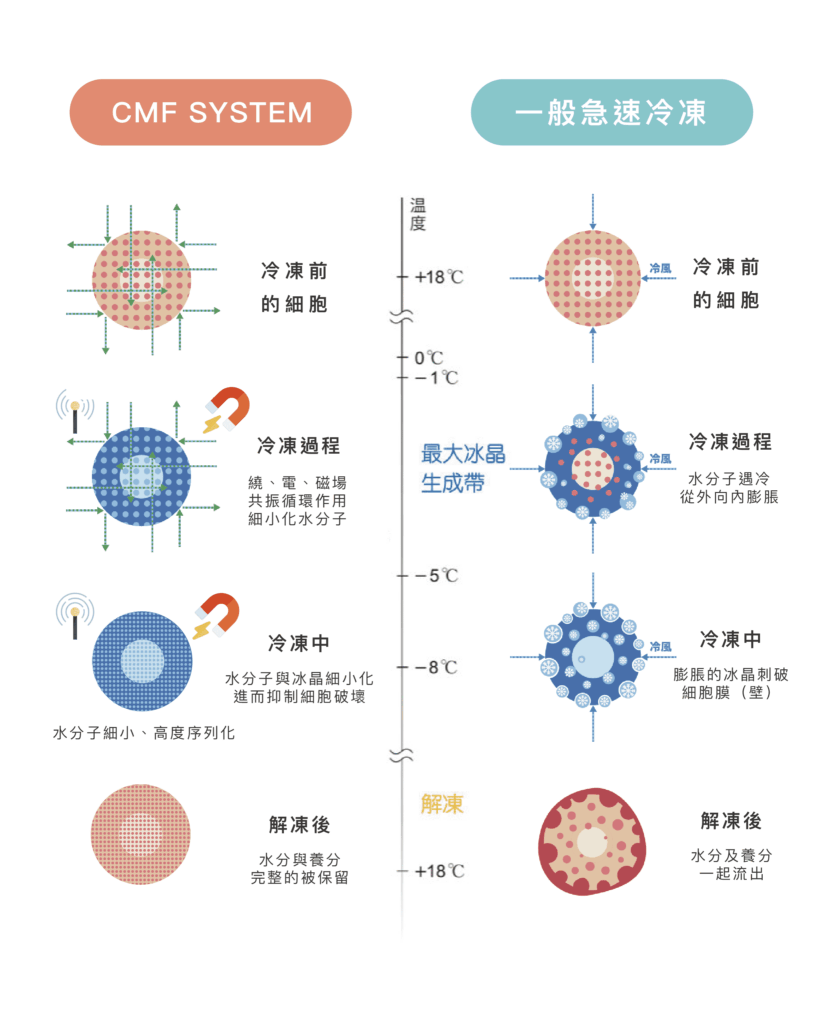
The freezing process utilizes a resonant cycle of flexural, electromagnetic, and magnetic fields to break down water molecules and ice crystals into smaller particles, thus inhibiting cell damage.
Preventing water molecules from damaging cells due to freezing expansion allows for more complete preservation of nutrients and ensures the freshness of frozen food.
TRADITIONAL FREEZING METHOD
Common problems with rapid freezing technology
Impact on food quality
The maximum ice crystal formation range is between -1 and 5 degrees Celsius; even with rapid freezing, water will still freeze at this temperature.
Ice crystals formed during freezing expand in volume, damaging cell membranes.
Because the cell membranes (walls) are ruptured, water, nutrients, and flavor components leak out after thawing, resulting in a decrease in the weight of the food.
- Even in extremely cold environments like -40°C, mold and yeast can continue to multiply within damaged cells, causing frozen foods to continue oxidizing, fermenting, and spoiling at low temperatures, thus affecting the quality of frozen foods.
Technological Advantages
- Rapid freezing combined with CMF technology can significantly reduce the energy required for freezing.
- Once cells are completely frozen, they only need to be stored at -18 degrees Celsius or below, which helps maintain the freshness of food and saves on food preservation costs.
- Food with fine ice crystals defrosts faster.
- After thawing, it retains its complete flavor while having a higher degree of freshness and a more attractive appearance.